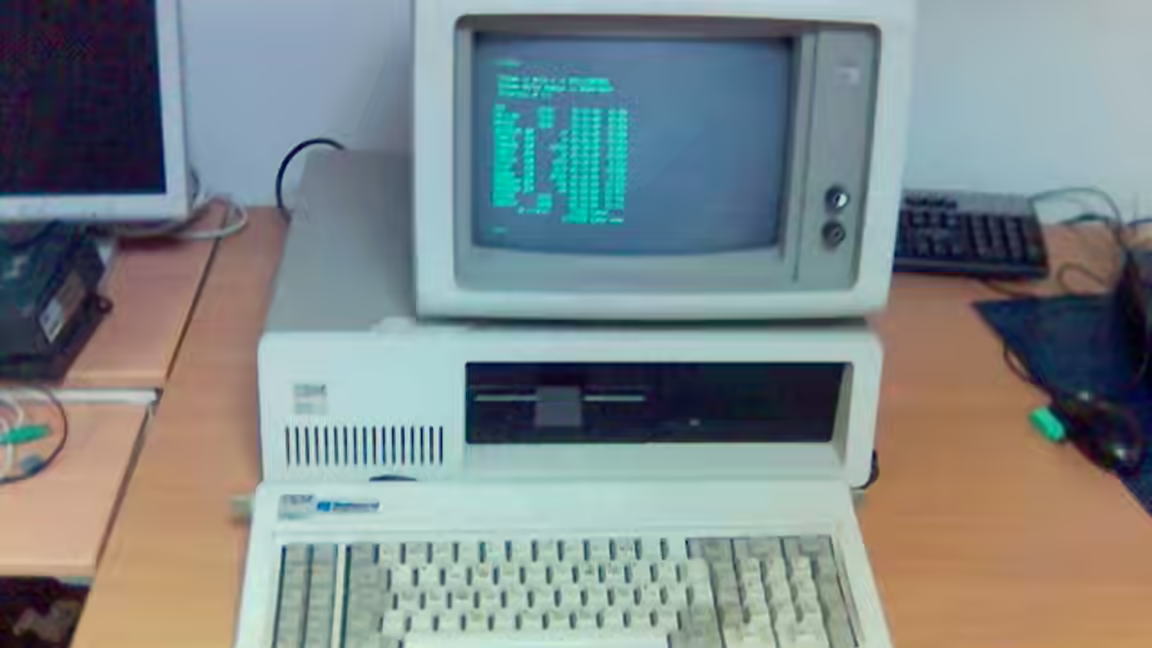
MartyPC, an open-source emulator for early IBM personal computers and compatibles, is drawing attention for an engineering approach centered on cycle-level behavior rather than basic software compatibility. The project supports IBM PC, XT and PCjr-class machines as well as Tandy systems, and runs on Windows, Linux and macOS.
The emulator began in April 2022 as a hobby project through which its developer could learn Rust. Its ambitions expanded as work moved toward cycle-accurate Intel 8088 emulation later that year. MartyPC is now positioned primarily as a tool for retro-computing developers who want to observe how programs interact with historical hardware in fine detail.
To validate the CPU model, the developer connected a physical 8088 processor to an Arduino Mega and compared real and emulated instruction execution one cycle at a time. The test system was later expanded to exercise the processor's prefetch queue, exposing timing discrepancies that could then be corrected. The repository reports 99.9997 percent cycle accuracy against its 8088 V2 test suite, a figure supplied by the project rather than an independent benchmark.
Hardware investigation has extended beyond the CPU. The developer describes testing the 8253 timer with an Arduino, measuring direct-memory-access timing with an oscilloscope and building a bus-sniffing setup around a logic analyzer. Those efforts are intended to reproduce the interactions among components that software on an original PC could depend upon, including effects that simpler functional emulators may not model.
The project cites two demanding demoscene programs as milestones. MartyPC became accurate enough to run 8088 MPH in April 2023, according to its documentation, and the following month it became the first PC emulator able to reproduce every effect in Area 5150. These demonstrations are relevant because such software deliberately pushes display hardware and timing behavior beyond conventional application use.
MartyPC also includes an extensive debugging interface. Developers can inspect disassembled instructions, CPU and peripheral state, and memory; set code and memory breakpoints; and create instruction- or cycle-based logs. Machine profiles can be extended through overlays that resemble adding expansion cards. Dual-video-card and multi-monitor configurations are supported, including combinations using MDA or Hercules adapters, with separate shader settings for each viewport.
The tradeoff is complexity. The maintainer says configuration may be less approachable than in other emulators, and users outside Windows—or those wanting the newest code—may need to compile the project themselves. Periodic releases are available, while automated development builds are distributed through GitHub Actions.
MartyPC's value therefore lies less in effortless game launching than in making early PC behavior measurable. For programmers studying 8088 software, timing-sensitive demos or peripheral interactions, it provides a laboratory that pairs emulation with unusually visible internal state.