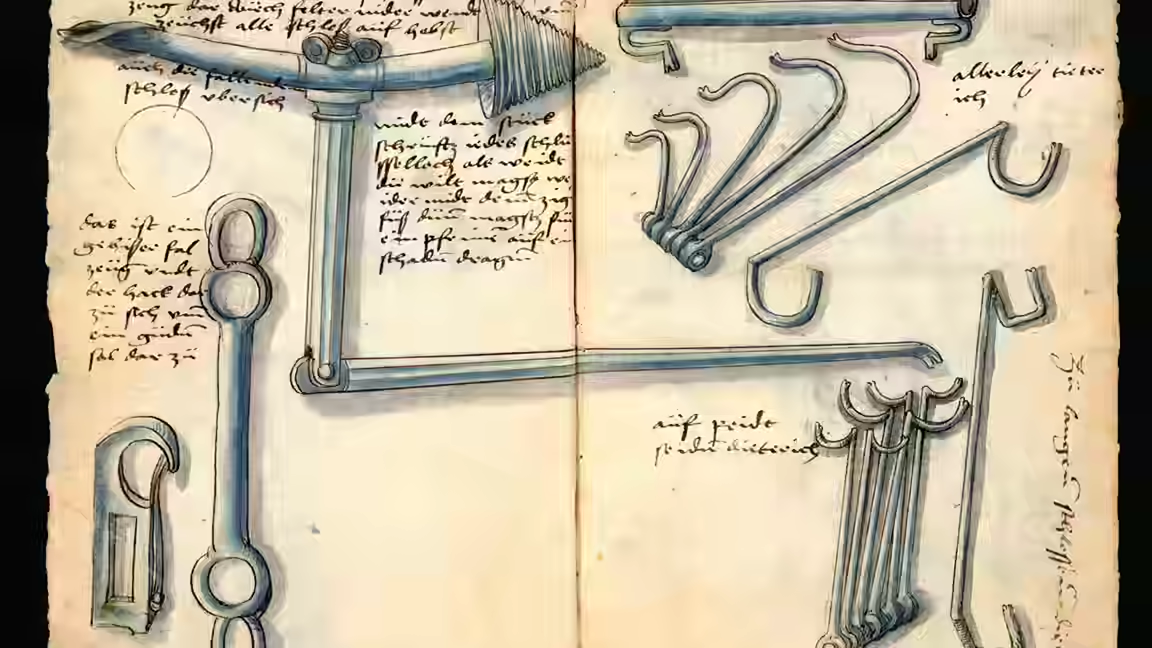
A workshop notebook returns to view
A digital research project is making a 16th-century Nuremberg technical manuscript easier to explore, pairing its digitized pages with transcriptions, English readings and explanations of the devices depicted. The Löffelholz Codex was begun in 1505 by Martin Löffelholz von Kolberg, a Nuremberg patrician and knight, and is now held by the Biblioteka Jagiellońska in Kraków.
The manuscript contains 154 pages devoted to practical objects rather than a conventional family chronicle. Its drawings and short captions cover drills with replaceable blades, thread-cutting tools, a vise-equipped workbench, locks, weapons and hunting equipment. More unusual concepts include a chair on casters, a movable spiral staircase and a cradle whose rockers contain mercury.
The project says the original manuscript has been fully digitized and is in the public domain, but no complete published transcription, edition or translation is known. Its website is therefore building a page-by-page guide that brings the facsimile together with a transcription in the manuscript's original spelling, a modern English reading and a proposed interpretation.
Review status stays visible
The site distinguishes editorially reviewed pages from raw transcriptions. Reviewed entries have been checked against the drawing and available research before their explanations are rewritten for clarity. Raw entries use AI-produced groundwork that has not yet received line-by-line correction; uncertain readings are marked and undeciphered text is left incomplete. The project explicitly labels interpretations as suggestions when a mechanism cannot be established.
That distinction matters because the manuscript uses Early New High German from Nuremberg, with inconsistent spelling and workshop vocabulary that may not appear in modern dictionaries. Understanding a page can require interpreting both the language and the physical operation of a depicted device.
Project lead Dirk Schornstein, an engineer and technology enthusiast, says AI assists with preliminary transcription and interpretation while reviewed pages receive substantial human checking. The website reported that 128 of the codex's 154 pages had been reviewed, leaving 26 still to examine. It also invites readers with relevant expertise to help resolve difficult pages and credits contributors who supply corrections.
The result is both a public-access reading aid and an evolving research record. Rather than presenting every image as a solved historical design, the project shows where its conclusions are secure, where the text remains uncertain and where further specialist input is needed.
For historians of technology, the presentation also lowers the barrier between viewing a scan and understanding it. A digitized manuscript preserves access to the source image; the layered transcription and commentary help non-specialists follow the language, identify components and evaluate how confidently a proposed machine can be reconstructed.